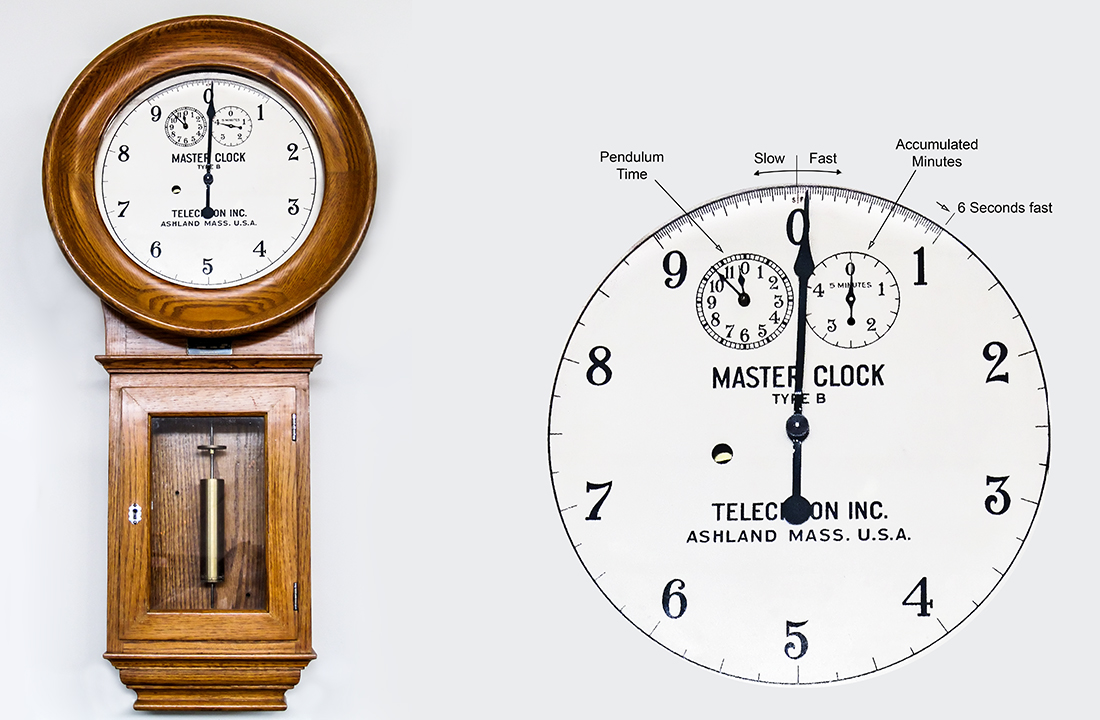
Power Station Master Clock
Today, in the interests of reliability and stability, modern utilities are networked together via large scale transmission lines into a huge electrical grid made up of dozens of utilities and hundreds of generators. Edmonton is part of the Alberta Interconnected System, which, in turn, is tied to BC, Washington, Oregon, California, and a number of other states making up the Western Interconnection grid, stretching from Alberta to Baja California. The frequency is precisely maintained within multiple decimal places of 60.0 Hz, and no one utility has the ability to significantly impact this frequency.
But it hasn't always been so. For the first hundred years or so of its existence, Edmonton Power's connection to other utilities was either tenuous or non-existent. This meant that Edmonton was solely responsible for maintaining system frequency at or about 60 Hz; utility load variations would cause frequency fluctuations which could result in errors of a few seconds during the course of a day. Now back in the day most lights, lamps, motors and industrial processes could tolerate small variations in line frequency, but the introduction of the low-cost synchronous motor in electric clocks meant that if the frequency did not at least average out to 60 Hz, these clocks (which were to be found in virtually every office, classroom, kitchen, living room and bedroom clock radio) would not display the correct time.
The solution was to be found in the Power Station Master Clock, patented in 1918. This device consisted of an electric clock connected to the AC mains supply and a precision mechanical clock with the dial indicating the difference between the electrical time and the mechanical time. It would then be the duty of the switchboard operator to watch the large hand. If he found that it was tending to move to the right of the zero, he would adjust the speed control switches so as to lower the frequency by a small amount. At the end of fifteen or twenty minutes, another observation would determine whether a further correction of the speed was necessary. If the hand tends to move to the left of the zero, the speed would be slightly raised. In general, the control of the speed should be such as to keep this large hand continually pointing to zero. It probably would not be necessary to make an adjustment more often than once every half hour although this period depended on several factors such as large variations in load, sensitiveness of turbine governors, etc.